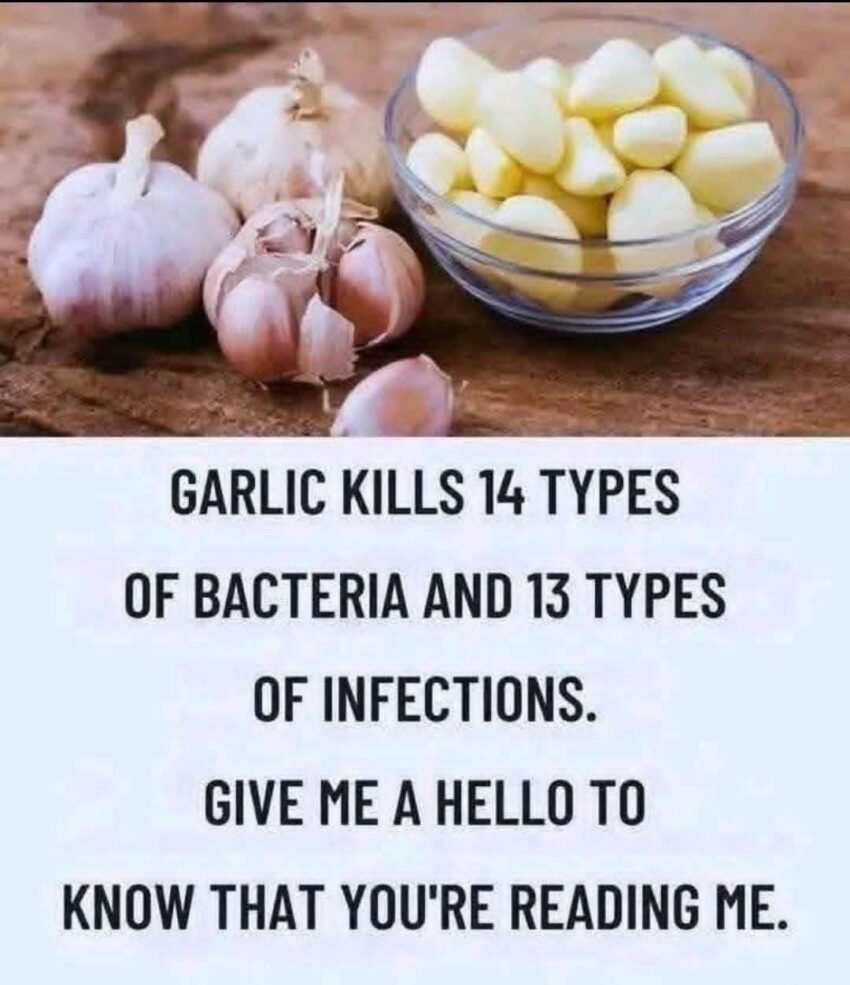
Here’s what research does show about garlic and microbes:
✅ What science supports
-
Garlic (Allium sativum) contains compounds like allicin and other sulfur-containing molecules that exhibit broad antimicrobial activity in laboratory (in vitro) studies. These compounds can inhibit the growth of many kinds of bacteria and fungi and disrupt microbial cell structures. RSC Publishing+1
-
Garlic extracts have shown inhibitory effects against a range of bacteria such as Escherichia coli, Staphylococcus aureus, Salmonella species, Klebsiella pneumoniae, Listeria and others in lab studies. MDPI+1
-
Garlic also shows antifungal activity and may have some antiviral effects in lab settings. RSC Publishing
⚠️ What it doesn’t mean
-
There is no verified list of exactly “14 bacteria” or “13 infections” that garlic has been proven to “eliminate” in humans. Those precise numbers are not documented in scientific literature and likely originate from oversimplified or exaggerated health claims.
-
Most research showing garlic’s antimicrobial effects is in vitro (in the lab), not in humans. Laboratory inhibition of bacteria does not automatically translate into treating infections in people at dietary or topical doses. Human bodies are far more complex than petri dishes.
-
Garlic’s antimicrobial strength varies widely depending on preparation, dosage, strain of bacteria, and experimental conditions. MDPI
Practical reality
-
Garlic has antibacterial properties in controlled lab studies, but it is not a clinically proven cure that reliably treats infections the way antibiotics do.
-
It might offer supportive benefits (e.g., modest antimicrobial activity, possible immune modulation), but relying on garlic alone to “eliminate infections” — especially serious ones — is not medically advised.
In short: garlic shows broad antimicrobial potential in research, but the specific claim of eliminating exactly 14 types of bacteria and 13 infections is not scientifically validated.